PhET Interactive Simulations, University of Colorado Boulder

PhET Interactive Simulations

PhET Interactive Simulations

STEM

Mathematics

Science

PhET Interactive Simulations provides 170+ open access and inclusive interactive STEM simulations, available in 120+ languages, fully downloadable for offline use, and used 250M times annually around the world.
website

Last updated: December 5, 2025

Overview

Learning objectives

Advance toward a world where science and math are inclusive, enjoyable, and empowering.

Evidence of impact

STRONG

Cost structure

3 Pricing models

Widely adopted in 195 countries

87 languages

Target audience: Educators and teachers

Early Childhood Education, Primary Education, Lower Secondary Education, Upper Secondary Education, Technical and Vocational Education, Tertiary Education

Full offline functionality

Smartphone, Tablet, Desktop/Laptop, Chromebook, Accessibility reader

Thumb Video 1
Teachers gather around a tablet displaying a PhET simulation about circuits.
Two students sit at a desk as they review their textbooks and interact with a tablet with a PhET simulation about pH.
Students work in a small group on a PhET simulation about gas laws.

The information presented is provided by the company, and reviewed in good faith. Learning Cabinet is not responsible for inaccurate content.

How this product was evaluated?

Product Details

Data protection and privacy

Privacy

  • Privacy Policy icon
    Privacy PolicyOpen info in a new page
  • Terms of Service icon
    Terms of ServiceOpen info in a new page
  • Product alerts users of significant changes to the privacy policy icon
    Product alerts users of significant changes to the privacy policy

Data Sharing

  • Product shares data with third parties icon
    Product shares data with third parties
  • Has data sharing agreements with these third parties icon
    Has data sharing agreements with these third parties
  • Product does not show external advertisements icon
    Product does not show external advertisements

Data Origin

  • Product does not utilize AI icon
    Product does not utilize AI
  • AI has not been trained using product datasets icon
    AI has not been trained using product datasets

Information security

  • Cybersecurity program in place icon
    Cybersecurity program in place
  • Technical best practices in place icon
    Technical best practices in place
  • Threat detection in place icon
    Threat detection in place
  • No self-assessments conducted icon
    No self-assessments conducted
  • No third party assessments conducted icon
    No third party assessments conducted

Safeguards

  • Product allows interactions between users and users can create content icon
    Product allows interactions between users and users can create content
  • Product does not use AI to generate content icon
    Product does not use AI to generate content
Theory

PhET uses multimodal interactivity, discipline-based education research, inclusive design, and extensive student interviews throughout the development process to ensure students achieve the intended objectives. Impact has been measured across 13,000+ global independent studies on student conceptual understanding, skills, attitudes toward STEM, and engagement. Refer to PhET's research page: https://phet.colorado.edu/en/research

Strong evidence of impact

Impact 3/3

PhET Interactive Simulations shows a proven positive impact, backed by at least one experimental study that shows a statistically significant positive impact on the intended learning outcomes.

Different levels of research evidence indicate the reliability of the proof of positive impact. The solutions featured in the Learning Cabinet range from:

  • Strong: Backed by at least one experimental study that shows a statistically significant positive impact on the intended outcomes.
  • Moderate: Backed by at least one quasi-experimental study that shows a statistically significant positive impact on the intended outcomes.
  • Promising: Supported by correlational or pilot research that indicates positive or promising results on the intended outcomes.

Evidence
External Evidence
Award or other recognitionOpen
Open link icon

PhET Founder & Nobel Laureate Carl Wieman was awarded the Yidan Prize in 2020--a global prize recognizing the strength of research on the use of PhET interactive simulations.

External Evidence
Quasi-experimental studyOpen
Open link icon

A literature review by Banda and Nzabanimana (2021) of 31 quasi-experimental studies (100% with PhET) showed learning gains 37% greater than control.

External Evidence
Other Academic StudyOpen
Open link icon

Implicit scaffolding embeds guidance directly into interactive simulations through affordances, constraints, cues, and feedback, improving conceptual learning while preserving student agency and self-directed exploration.

Engagement
Icon representing engagement statistics

Recommended use

Early Childhood Education, Primary Education, Lower Secondary Education, Upper Secondary Education, Technical and Vocational Education, Tertiary Education

PhET simulations are available for early learners through university education. Simulations are akin to virtual laboratory spaces (in science) or digital manipulatives (for math), and are most effective for exploration and laboratory experiences. Duration and frequency are very variable.

PhET simulations are available for early learners through university education. Simulations are akin to virtual laboratory spaces (in science) or digital manipulatives (for math), and are most effective for exploration and laboratory experiences. Duration and frequency are very variable.

Icon representing engagement statistics

Target audience

Students, Teachers
Wide
reach
10%
User growth rate
195
Countries

Learning Objectives

Advance toward a world where science and math are inclusive, enjoyable, and empowering.

Convocation hat icon

Curriculum

  • Adaptable to different curriculums
  • Not tied to any specific curriculum

Information about curriculum

We create simulations where there is a gap in high-quality digital tools for math and science topics, while also considering teachers' expressed needs and the requests of our donors who support the creation and maintenance of simulations. We consider the widely-accepted domain of math and science knowledge more than any particular curriculum. However, we provide alignment guidelines for the U.S. Next Generation Science Standards, U.S. Common Core State Standards, and any curricular documents that users might contribute to our website.

Pedagogical design

PhET simulations are developed using design principles that incorporate discipline-based education research (known learning difficulties in math and science) and inclusive design. Refer to "A Study of Educational Simulations Part 1 - Engagement and Learning" uploaded in a prior section of this application. https://www.learntechlib.org/noaccess/24230/

Accordion toggle
Additional Details
Flexibility
The product allows learner agency (e.g. it provides flexibility for the learner or teacher to make choices, take actions, or influence their learning outcomes and experiences).
Teachers and students may use simulations for whole class discussion, small group work, independent work, and distance learning.
Learner engagement
The product has interactive design where a learner can interact with the content via different actions, like for example solving problems.
Many simulations have progressive "screens" with differing levels of complexity or emphasis on specific sub-objectives.
Creativity
The product allows content creation
The product includes problem-solving activities
Collaboration
PhET sims are designed to increase learner-learner and teacher-learner discourse, but this happens external to the technology.

User Experience

Accordion toggle
User interface

The design of PhET simulations is based on hundreds of interviews to iteratively refine our user interface approaches and scaffolding. Each individual PhET simulation is tested through at least 4-8 student interviews. We also make efforts toward compliance in design and functionality to make simulations compatible with voicing (for users without screen readers) and interactive description (for visually-impaired users with screen readers). 

Open Product Screenshots
Accordion toggle
Data-driven product development

As PhET does not collect PII on users, we cannot track specific instances of use. However, we have more than two decades of experience interviewing students around the world as we have designed simulations. We have extensive interactions with teachers as well, who regularly provide feedback about desired changes through our many public channels (e.g., PhET Help Desk, teacher workshops, social media, etc.). A large portion of our team includes prior (and current) math and science educators, who regularly use PhET simulations with their students.

Accordion toggle
Geographic focus

PhET designs simulations for use globally. However, many simulations have localization features that include "cultural sets", such as characters wearing locally-relevant clothing.

Accordion toggle
Ensuring content quality
Expert Review: Content is reviewed by subject matter experts.
Educational Standards Alignment: Content aligns with educational standards.
User Feedback Incorporation: Regular updates are informed by user feedback.
Evidence-Based Content: Content creation is based on current educational research.
Quality Assurance Processes: Implementation of rigorous quality control measures.
Editorial Oversight: Editorial teams oversee content development and accuracy.
Language Accuracy: Content undergoes professional linguistic and grammar checks.

Infrastructure

  • Device compatibility
    Smartphone, Tablet, Desktop/Laptop, Chromebook, Accessibility reader
  • Designed for low-cost devices
    Yes
  • Environment
    Web-Based (Accessible via a web browser without requiring installation on a device), Device Installable (Requires installation on a device to be used, i.e. a mobile or desktop app)
  • Offline availability
    Full offline functionality
  • Integration with 3rd party
    Education/Learning Data tools, LMS platforms, See phet.colorado.edu/en/our-supporters

Support

  • Training materials
    Video tutorials, User manuals, Webinars, Online courses, Community forum, Live training
  • Training material languages
    English, Portuguese, Spanish,
  • Training material target users
    Educators and teachers
  • Technical support

    Image for Technical support 1
    Email Support

    Image for Technical support 3
    Community Support

    Community Support

    Forum, Social Media page (Facebook, Instagram, or others), Community chat (Discord, Slack, WhatsApp groups), Certified experts directory


    Image for Technical support 6
    WhatsApp (for teachers in courses)

Local Adaptability

  • Curriculum / educational content can be customized
    Yes
  • Visual / audiovisual content can be customized
    Yes
  • Content can be customized
    Yes
  • Current languages
    Afrikaans, Albanian, Amharic, Arabic, Armenian, Basque, Bengali, Bislama, Bosnian, Bulgarian, Burmese, Catalan, Chinese Traditional, Chinese, Hong Kong, Chinese, Simplified, Cinyanja, Croatian, Czech, Danish, Dutch, English, Estonian, Ewe, Faroese, Farsi, Filipino, Finnish, French, Friulian, German, Greek, Gujarati, Hebrew, Hindi, Hungarian, Icelandic, Indonesian, isiXhosa, Italian, Japanese, Japanese, Kannada, Khmer, Korean, Kurdish, Laotian, Latvian, Lithuanian, Macedonian, Malay, Maltese, Mandarin, Marathi, Marathi, Moldavian, Mongolian, Nahuatl, Northern Sami, Norwegian, Norwegian Bokmal, Norwegian Nynorsk, Oriya, Polish, Portuguese, Purépecha, Romanian, Russian, Serbian, Serbo-Croatian, Simplified Chinese, Sinhala, Slovakian, Slovenian, Spanish, Swahili, Swedish, Tamil, Telugu, Thai, Tswana, Turkish, Ukranian, Urdu, Uzbek, Vietnamese, Welsh, Zulu
  • Possibility to translate the product to new language
    Yes
  • Current writing systems
    Arabic, Chinese, Indic Scripts, Latin Alphabet
  • Licensing information
    • The content is open source

Data import/export

  • Export data capability
    API available to licensed partners.
  • Exportable data types
    Simulation interaction data
  • Import data capability
  • Automation
Affordability

Affordability Card

Business model icon
Business model
  • Business to Consumer (B2C)
  • Business to Government (B2Gov)
  • Business to Business (B2B)
Pricing model icon
Pricing model
  • Free
  • Freemium/Premium
  • Open-core
Pricing tiers icon
Pricing tiers
  • District based
  • National
  • School based
Convocation hat icon

Pricing available per request

    Ask for details
    Email icon

    Pricing Strategy

    Free: Access to PhET's core simulations and teacher resources are completely free. PhET's teacher professional development is available for free on Coursera (when auditing).

    Premium: PhET Studio (customization tool) is available for an annual license (currently $50/yr), only available for educators/institutions with a U.S. credit card, although global international agreements may someday be possible through institutional agreements.

    Partnership: EdTech companies that desire licensing of PhET branding, access to our API service (metadata, software updates, etc.), and technical or pedagogical support, can enter into a partnership agreement for a fee.

    Adjustable Pricing Options

    Our mobile PhET Apps, available on Apple App Store and Google Play, use context-dependent pricing. Additionally, while PhET Studio is not currently available outside of the U.S., we expect to someday have a tiered pricing model. Partnership pricing also varies, with discounted commercial partnerships available for companies based in developing countries.

    Organisation and Operations

    Organization Details

    Developed in
    United States
    Type of organization
    Academic institution
    Stage of organization
    Growth Phase
    (since 2002)
    Number of employees
    25-50
    Developed in
    United States
    Type of organization
    Academic institution
    Stage of organization
    Growth Phase
    (since 2002)
    Number of employees
    25-50
    Developed in
    United States
    Type of organization
    Academic institution
    Stage of organization
    Growth Phase
    (since 2002)
    Number of employees
    25-50
    Convocation hat icon

    Experience with large projects

    • Open link iconPartnership models with national institutions
    Case Study Link
    Open link icon

    Large implementation example

    PhET routinely manages multimillion dollar grants and large service agreements. Our funders/collaborators have included The Gordon and Betty Moore Foundation, Yidan Prize Foundation, U.S. National Science Foundation, Verizon, Mastercard Foundation, Hewlett Foundation, Google.org, The O'Donnell Foundation, and other donors and supporters. Refer to https://phet.colorado.edu/en/our-supporters

    These projects have included large-scale technology projects (development of new simulations, creation of infrastructure) and educational development projects (e.g., PhET Fellowships in Africa and Latin America, reaching 124K+ teachers).

    Accessibility of Design

    Users with disability have been taken into account in the design of the product.
    Success iconPhET Interactive Simulations does not fulfil the WCAG 2.1 level AA requirements
    Tool tested with:
    successAutomatic tools
    successExpert validation (using free NVDA screen reader)
    successPerson with disability

    Equity of access & Gender

    Accordion toggle
    Product usage between genders

    Although we are not able to directly measure usage by gender, we promote evidence-based although we promote evidence-based gender-sensitive strategies (and have observed increased use of those strategies) in the communities that we impact.

    Get in touch with the organization

    Contact Person picture
    Director of Global Initiatives
    Rebecca Vieyra
    Diagram explaining the EdTech for Good Framework

    Expert Review of PhET Interactive Simulations

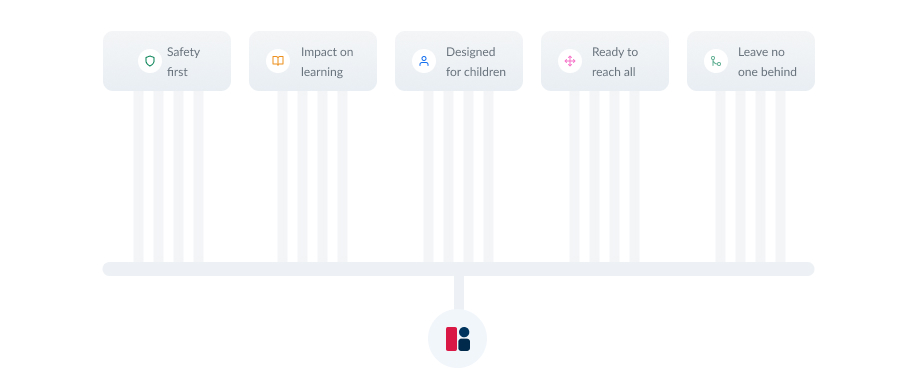
    Evaluated using the Learning Cabinet’s rigorous EdTech for Good Framework to ensure safety, learning impact, scalability, and inclusion for all learners.

    EdTech for Good Framework

    Similar Products

    1